


OMIM ID:
Hallermann-Streiff Syndrome
Alternate Names
Defective Genes
Clinical Characteristics
Ocular Features
Nearly all patients (80+ %) have microphthalmia and bilateral congenital cataracts. Microcornea is common. The eyebrows may be hypoplastic and the eyelashes likewise are sparse. The lid fissures often slant down and telecanthus has been noted. The distance between the two eyes appears reduced. Blue sclerae, nystagmus, strabismus, and glaucoma are present in 10 to 30% of patients.
Systemic Features
The facies are sometimes described as ‘bird-like’ with a beaked nose, brachycephaly, and micrognathia. Microstomia with a shortened ramus and forward displacement of the termporomandibular joints is characteristic. Upper airway obstruction may occur with severe respiratory distress. The forehead is relatively prominent, the palate is highly arched, and the teeth are often small and some may be missing with misalignment of others. A few teeth may even be present at birth (natal teeth). Children appear petite and are often short in stature. Scalp hair is thin, especially in the frontal and occipital areas, and the skin is atrophic. Developmental delays are common but most patients have normal or near-normal intelligence.
Genetics
Inheritance
Most cases are sporadic but some have mutations in the GJA1 gene (6q21-q23.2). Both autosomal dominant and autosomal recessive inheritance have been postulated. Reproductive fitness may be low but rare affected individuals have had affected offspring. Males and females are equally affected.
This disorder is allelic to oculodentodigital dysplasia (257850, 164200).
Pedigree
Autosomal dominant
Autosomal dominant disorders require only one mutation for the disease to be expressed. Since an affected parent has two chromosomes, only one of which has the mutant gene, parents can expect that half (50%) of their children will receive that one and inherit the disease. It is common for individuals that inherit the mutation, however, to not have evidence of the disease (nonpenetrance).
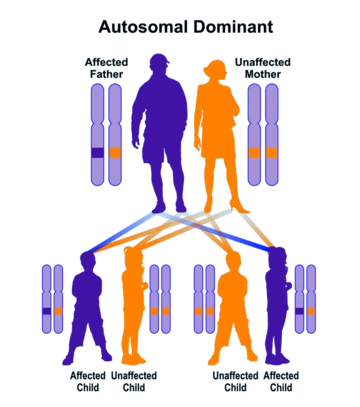
Autosomal dominant inheritance leads to a vertical pattern of transmission
Autosomal recessive
In order for autosomal recessive disorders to be expressed, offspring generally must inherit two mutations, one from each carrier parent. Carriers with only one mutation, such as the parents, do not have clinical disease. Note that carrier parents can expect that 1 in 4 children (25%) will inherit both mutations and have the disorder, 2 in 4 children (50%) will be carriers like their parents, while 1 in 4 children (25%) inherit neither mutation.

In order for autosomal recessive disorders to be expressed, offspring generally must inherit two mutations, one from each carrier parent. Carriers with only one mutation, such as the parents, do not have clinical disease. Note that carrier parents can expect that 1 in 4 children (25%) will inherit both mutations and have the disorder, 2 in 4 children (50%) will be carriers like their parents, while 1 in 4 children (25%) inherit neither mutation.